

 Donor Nexus Team
September 30, 2026

The short answer
Embryo adoption through an adoption-model program commonly costs $10,000 to $15,000 for matching plus a $2,000 to $3,500 home study. Embryo donation through the Donor Nexus Donor Embryo Program is $9,400 USD per cycle with no home study, including 1 to 3 embryos, administrative costs, and one year of storage.1,2
In both models, pretesting, medications, monitoring, and the frozen embryo transfer are billed separately by the fertility clinic, so the total cost of a cycle depends on clinic fees and travel.
The cost of a donor embryo cycle comes from two places: the fee charged by the program that provides the embryos, and the medical fees charged by the fertility clinic that prepares the recipient and performs the transfer. Adoption-model programs and medical donation programs such as the Donor Embryo Program at Donor Nexus structure those fees differently, which is why prices found online can be hard to line up. This guide breaks down each part of the bill so you can compare programs on the same terms and plan your own budget.
You may see the phrase embryo adoption used for any program that places donated embryos, but the two models follow different legal frameworks, and the Ethics Committee of the American Society for Reproductive Medicine (ASRM) considers the term adoption inaccurate for embryos.3 The framework matters for your budget because an adoption model adds steps like a home study and a longer matching period, while the donation model treats the embryos as donated reproductive tissue. For the full side-by-side of the two approaches, see how embryo adoption and embryo donation differ.
How does embryo adoption cost compare with embryo donation?
Before any clinic fees, an adoption-model program commonly adds up to $12,000 to $18,500 once matching and the home study are combined, compared with $9,400 for the Donor Embryo Program.1,2 The table below lines up what each fee covers and how long each path usually takes before transfer.
| Cost item | Donor Embryo Program | Adoption-model program |
|---|---|---|
| Program fee | $9,400 USD per cycle | $10,000 to $15,000 for matching services |
| Home study | Not required | $2,000 to $3,500 |
| What's included | 1 to 3 embryos from your selected profile (untested profiles may include 3 or more), administrative costs, and one year of storage | Matching services; pretesting, medications, and transfer are not included |
| Timeline to transfer | Typically 2 to 3 months from selecting a profile | Typically 8 to 14 months |
| Where transfer happens | HRC Fertility in Newport Beach or Encino, California | Varies by program |
| Billed by the clinic | Pretesting, medications, monitoring, and frozen embryo transfer | Pretesting, medications, monitoring, and frozen embryo transfer |
Program fees before your transfer. Pretesting, medications, and the frozen embryo transfer are billed by the clinic in both models.
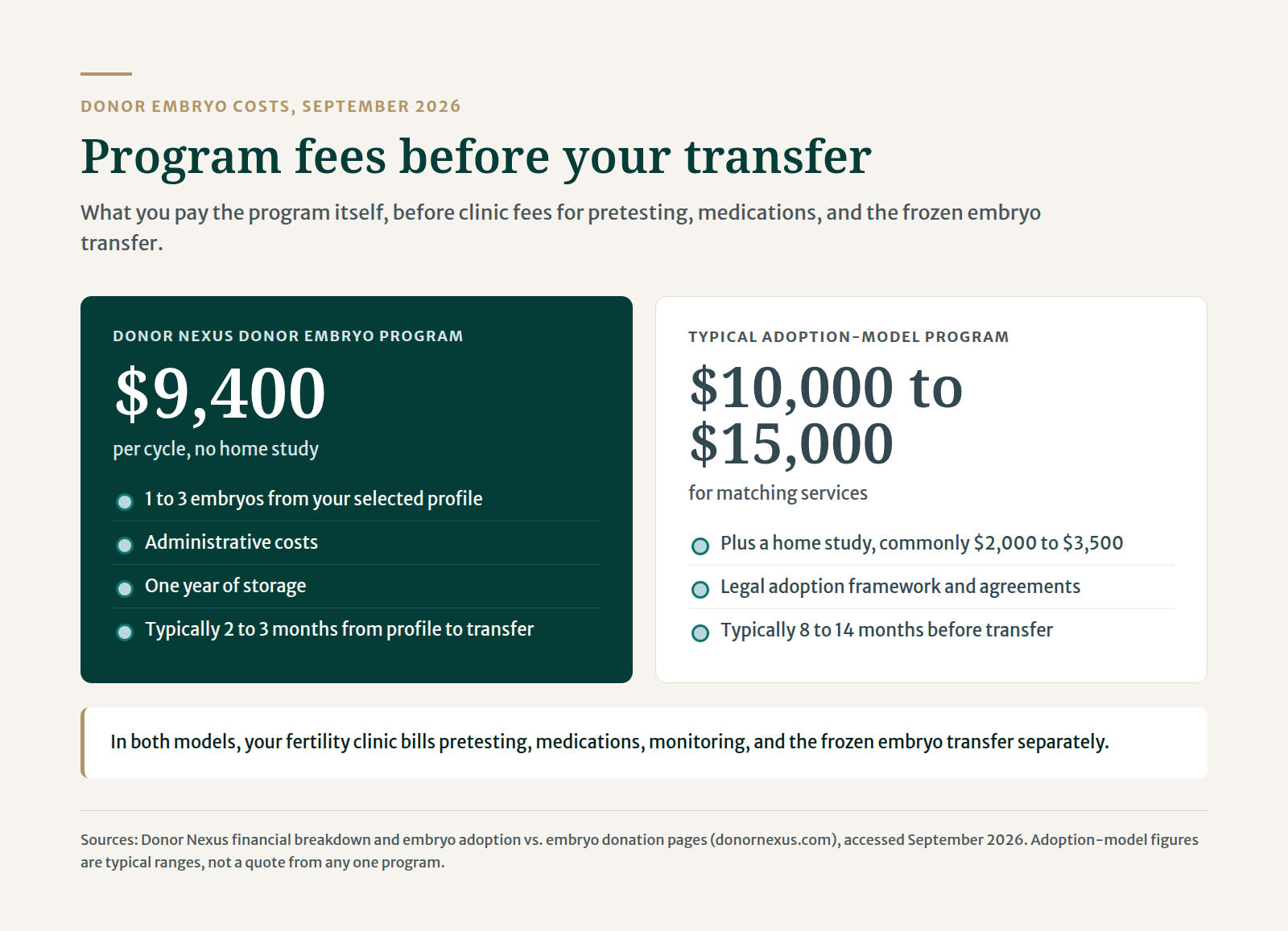
The $9,400 fee for the Donor Embryo Program includes 1 to 3 embryos from the profile you select, and profiles with untested embryos may include 3 or more.1,4 Because more than one embryo is included, you have more than one opportunity for a transfer from the same profile, and one year of storage keeps any remaining embryos frozen while you and your physician plan the next step.4
How much does a home study add on its own?
A home study for an adoption-model program typically adds $2,000 to $3,500 to the bill, based on the embryo adoption figures Donor Nexus lists.2 A federal adoption resource from the Child Welfare Information Gateway notes that a private agency or certified home study specialist might charge $1,000 to $3,000, and that the process takes 3 to 6 months on average.5 Those months can also delay pretesting and the transfer that follows, which is part of why adoption-model timelines run longer. To see what a home study involves and why the donation model doesn't use one, read do you need a home study to receive donor embryos.
What costs does the fertility clinic bill separately?
Your fertility clinic bills the medical side of the cycle directly, and those fees are not part of the $9,400 program fee: pretesting, medications, monitoring, the frozen embryo transfer, and PGT-A testing if you request it.1 If you live outside Southern California, pretesting and monitoring can usually be done at a clinic near you, while the transfer itself takes place at HRC Fertility.4 The clinic charges follow the order of the cycle:

- Pretesting. Your IVF physician orders a uterine cavity evaluation, either a sonohysterogram or a hysteroscopy with a mock embryo transfer, along with a state-mandated infectious disease panel for you and your partner.6
- Medications. You take medications for about 35 days before the embryo transfer.6
- Monitoring ultrasounds. Most cycles include 2 to 3 monitoring ultrasounds during the medication phase.6
- Frozen embryo transfer. The embryo is thawed and transferred at HRC Fertility in Southern California.6
- Pregnancy test. Your first blood bhCG level is drawn 10 to 12 days after the transfer.6
- PGT-A testing, if requested. Genetic testing of embryos is optional and billed separately by the clinic.1 Some profiles list embryos that were already tested, which you can read about in how to choose a donor embryo.
Clinic prices vary by location and by what your physician orders, so the most useful step is to ask your clinic for an itemized estimate that covers each line above. If you are over 45, most physicians also order additional testing, typically a stress test, EKG, chest X-ray, mammogram, and pap smear, and those tests can add to the pretesting total.6 Pretesting results are generally valid for up to 12 months, so timing your cycle within that window can help you avoid repeating tests.6
How much should you plan for travel to Southern California?
Plan for about 4 days in Southern California, because donor embryos in the program are stored at partner fertility clinics and cannot be shipped to another clinic.4,7 Most physicians require 2 days of bed rest after the transfer, which shapes a typical trip:6
- Arrive the day before your transfer.
- Complete the frozen embryo transfer at HRC Fertility in Newport Beach or Encino.
- Rest for 2 days, as most physicians require.
- Travel home on the fourth day.
When you build your travel budget, include airfare or driving costs, lodging for the stay, local transportation to the clinic, meals, and any time away from work for you and a partner or support person. Because pretesting and monitoring can happen at your local clinic, most of the cycle can take place close to home, with your travel centered on the transfer. If you are traveling from outside the United States, the guide for international patients covers what to plan for when the transfer takes place in Southern California.

What happens to your cost if an embryo doesn't survive the thaw?
If an embryo doesn't survive the thaw, the laboratory can thaw another embryo from the same profile without you starting over.6,4 This is one reason the program fee includes 1 to 3 embryos, and the process follows these steps:6
- The laboratory is instructed to thaw another embryo from the same profile, if one is available.
- If the profile has no remaining embryos, Donor Nexus reaches out to you with a backup embryo profile.
- You choose whether to thaw an embryo from the backup profile.
- If the backup profiles don't meet your desired criteria, you can receive a refund or credit instead.
Clinic fees for the medication cycle and transfer day are separate from the program fee, so ask your clinic in advance how it bills if an additional thaw is needed on transfer day. To understand how often transfers in the program have led to pregnancy, see donor embryo success rates.
How can you manage the cost of a donor embryo cycle?
You can manage the cost with a fertility loan, grants, a benefits check through your clinic, and an early conversation with the Donor Nexus team about payment timing.1 Each option addresses a different part of the bill:
- Financing. Donor Nexus partners with CapexMD for fertility loans, which can spread the program fee and clinic costs over time.1
- Grants. The IVF grants page lists financial assistance you can apply for directly, with 2026 deadlines and eligibility, and many of the listed grants also cover costs associated with donor eggs and donor embryos.8
- Insurance through your clinic. Donor Nexus doesn't bill insurance, but many fertility clinics accept insurance for portions of the IVF process, so a benefits check can clarify what your plan covers.1
- Payment timing. The two-installment schedule on the financial breakdown page is described for donor egg programs, with a deposit to secure a donor or frozen cohort and a second payment later, so ask the team how payment timing works for the Donor Embryo Program before you secure embryos.1
If you have already found a donating family on your own, through friends or an online community, Independent Match Embryo Coordination starts at $6,500 USD, and the recipient is responsible for transportation costs and legal fees for both parties.9 The guide to private embryo donation matches compares that path with choosing a profile from the embryo bank.
Frequently asked questions about donor embryo costs
How much does it cost to adopt an embryo?
Adoption-model programs commonly charge $10,000 to $15,000 for matching, plus $2,000 to $3,500 for a home study, before any clinic fees. Through embryo donation at Donor Nexus, the program fee is $9,400 USD per cycle with no home study. In either model, your clinic bills pretesting, medications, monitoring, and the frozen embryo transfer.
Is embryo donation cheaper than donor eggs?
The program fee is usually lower. Donor Nexus lists $19,500 to $29,500 USD for a six-egg cohort from the Frozen Egg Bank and Fresh Matching starting at $29,600 USD, compared with $9,400 for the Donor Embryo Program. Donor egg cycles also carry clinic IVF fees, so compare full estimates using the financial breakdown.
Does insurance cover donor embryo cycles?
Donor Nexus doesn't bill insurance, so the program fee is paid directly. Many fertility clinics do accept insurance for portions of the IVF process, depending on your plan. Before pretesting begins, ask your clinic to run a benefits check so you know which parts of the medical cycle may be covered.
Are embryo donors paid?
No. Embryo donors do not get paid for donating their embryos. Donating families can be reimbursed for specific costs related to the donation, such as shipping, storage fees, clinic administration, and legal fees. To learn more about the donor side and why families choose to donate, read why families donate embryos.10
Once you have a sense of the program fee, the next step is to register for free and browse profiles in the embryo bank, then ask your fertility clinic for an itemized estimate for pretesting, medications, and transfer. If you have questions about fees, payment timing, or travel, the Donor Nexus team can walk through them with you at info@donornexus.com or +1 (949) 433-5635, Monday to Friday, 8 a.m. to 4 p.m. Pacific. You can also read more about the embryo donation process step by step or return to the Donor Embryo Program overview.
Sources
- Donor Nexus. Financial breakdown: program costs, what is included, and payment options. Accessed September 2026. https://donornexus.com/financial-breakdown.
- Donor Nexus. Embryo adoption vs. embryo donation. Accessed September 2026. https://donornexus.com/embryo-adoption.
- Ethics Committee of the American Society for Reproductive Medicine. Defining embryo donation: an Ethics Committee opinion. Fertility and Sterility. 2023;119(6):944-947. doi:10.1016/j.fertnstert.2023.03.007.
- Donor Nexus. Donor Embryo Program. Accessed September 2026. https://donornexus.com/embryo-donation.
- Child Welfare Information Gateway. The Adoption Home Study Process. U.S. Department of Health and Human Services, Administration for Children and Families, Children's Bureau; 2020. https://www.childwelfare.gov/pubPDFs/f_homstu.pdf.
- Donor Nexus. Embryo donation process. Accessed September 2026. https://donornexus.com/embryo-donation-process.
- Donor Nexus. Embryo donation for international patients. Accessed September 2026. https://donornexus.com/embryo-donation-abroad.
- Donor Nexus. IVF grants. Accessed September 2026. https://donornexus.com/ivf-grants.
- Donor Nexus. Independent embryo coordination. Accessed September 2026. https://donornexus.com/embryo-coordination.
- Donor Nexus Team. Why donate embryos. Donor Nexus Blog. Accessed September 2026. https://blog.donornexus.com/why-donate-embryos.
Related reading


Medical disclaimer
This article shares general information about donor embryo and embryo adoption costs and is not medical advice. Your fertility doctor knows your history and treatment plan, so their guidance comes first. National figures and Donor Nexus outcome data describe past results and do not predict the outcome of any individual cycle.
Last updated October 2026. Figures cited here are drawn from the sources listed above.

Donor Nexus Team
The Donor Nexus Team is the group of case managers, donor coordinators, and egg bank staff who run the agency's Fresh Donor Matching, Frozen Egg Bank, and Embryo Donation programs day to day. Since 2012 they ha…

Ready for the next step?
If you are ready to get started or just need more info, contact us today.