

 Donor Nexus Team
May 2, 2025
Donor Nexus Team
May 2, 2025

In the Donor Nexus donor embryo database, you will find several donor embryos available for Open ID donations, giving you the opportunity to exchange identifying information with the embryo donor(s).
While embryo donation and embryo adoption both involve receiving frozen embryos from families who have completed their own IVF cycles, it is important to understand how the requirements differ.
Embryo Donation: Typically follows a medical and legal model where the embryo is a generous gift. It is often a more streamlined, cost-effective process with shorter timelines and no home study requirements.
Embryo Adoption: Often follows an adoption-based model that treats the embryo similarly to a child. This path generally involves higher costs, longer wait times, and a rigorous home study process.
Embryo Donation vs. Embryo Adoption Overview
Embryo donation and adoption share similarities, with several key differences in process, cost, timeframe, and home study requirements.
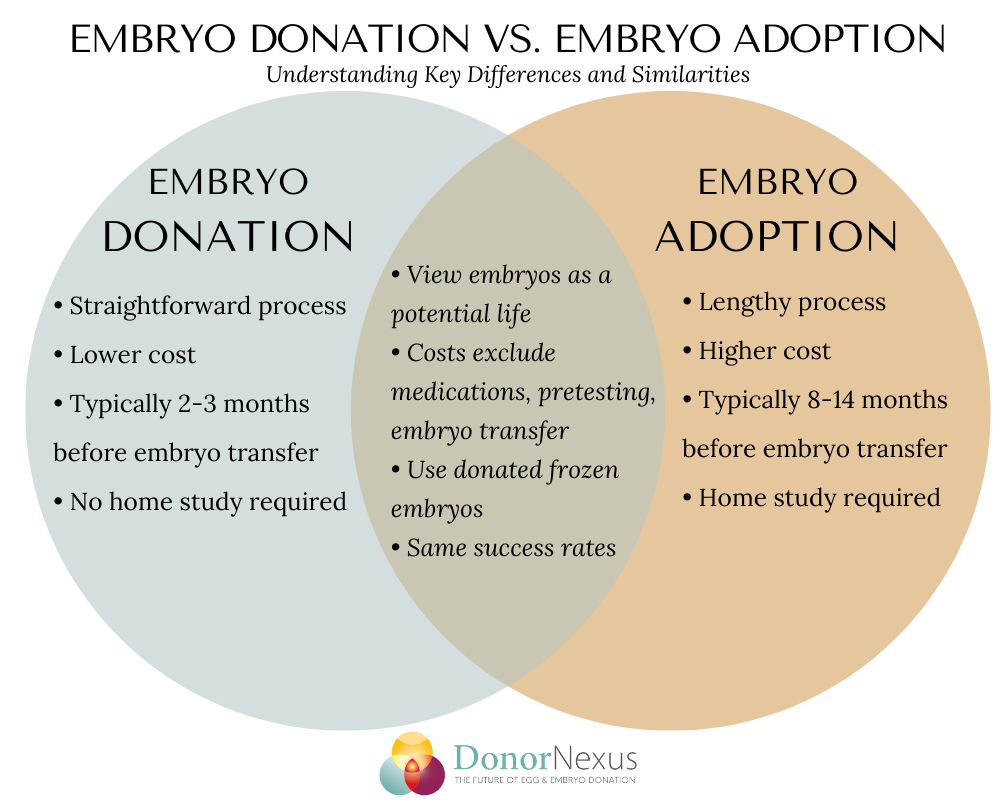
With our flexible embryo donation program, we are able to meet the needs of many IVF patients who come to us initially seeking embryo adoption. We simplify the process of using donor embryos without compromising your chances of success.
Embryo Donation: Key Benefits
According to the American Society for Reproductive Medicine (ASRM), embryo donation is a long-standing, established path to parenthood option. Because the embryos are already created, the process is often less physically demanding and more affordable than traditional egg donation.
It can also offer a deep sense of purpose to the embryo donors, who find fulfillment in knowing their gift is helping another family grow.
Simplified Process:
- Embryo adoption often involves a comprehensive home study, a lengthy and invasive process that can delay your journey to parenthood.
- Our embryo donation program eliminates this requirement, allowing you to focus on what truly matters, growing your family.
- Many of our patients deliver within about 12 months of securing a donor embryo!
As Ellen S. Glazer, LICSW, Guest Contributor to Harvard Health states, "the opportunity to experience pregnancy draws some prospective adoptive parents to seek embryo donation. This may be important to you. It may be a life experience you always looked forward to, or hoped to share with a spouse or partner."
Cost-Effective:- By removing the need for a home study, we reduce both the time and financial burden typically associated with embryo adoption.
- This makes embryo donation a more affordable option, ensuring that more families can access donor embryos to pursue their family-building goals.
High Success Rates:
Donor Nexus partners with HRC Fertility in Southern California for our donor embryo cycles, providing donor embryo success rates above national averages.

This is based on the latest statistics available from the Center for Disease Control and Prevention (CDC). Please note that the most recent year with finalized results is 2021.
Our success rates are as follows:
- Positive Pregnancy: 69.5%
- On-Going Pregnancy / Live Birth Rate: 49.0%
How Does the Donor Nexus Embryo Donation Program Work?
Our embryo donation program is designed to be straightforward and accessible to any loving couple or individual seeking to use donor embryos to start or grow their family.
Here’s how you can get started:
- Register to Browse Donor Profiles: Create an account to access our extensive donor embryo database. Browse through detailed profiles to find your perfect match.
- We offer both Open ID and Nonidentified donor embryo cycles. The donating couple or individual's preference is clearly listed on their online profile, allowing you to choose the option that best suits your needs.
- Consult with Our Team: If you have questions or need guidance, our experienced team is here to help. We offer consultations in person, over the phone, or via Zoom, to help you navigate your options and the donor embryo IVF process.
- Prepare for Embryo Transfer: Once you’ve secured a donor embryo, you will begin the pretesting and preparation process with your IVF physician. If you are not local to Southern California, this phase can typically be done at a fertility clinic close to you. However, the embryo transfer will need to take place at our partner clinic, HRC Fertility, requiring you to spend a total of 4 days in beautiful Southern California.
Donor Nexus
Since our establishment in 2012, Donor Nexus has helped over 1,200 families achieve their dreams of parenthood. Our commitment to providing personalized, compassionate care sets us apart. Here’s why families choose us:
- No Wait List: Start your journey without delays. Our efficient process means you can move forward quickly, often completing cycles within 2-3 months.
- High Success Rates: Partnering with HRC Fertility, we offer success rates above national averages, giving you the best chance for a positive outcome.
- Flexible Donation Options: Choose from nonidentified or open ID donations, tailoring the experience to your preferences and needs.
Start Your Journey Today
Embark on your path to parenthood with Donor Nexus – our embryo donation program is similar to an embryo adoption program with no home study required. Register now to access our donor database and take the first step towards growing your family!
For more information or to schedule a consultation, connect with us. We’re here to support you in any way we can.

Embryo Donation: Frequently Asked Questions
1. How is embryo donation different from embryo adoption?
The main difference is the legal process. Embryo adoption follows adoption law and requires a lengthy home study. Embryo donation is a medical and legal transfer via contract, which eliminates the home study, lowers costs, and speeds up the timeline.
2. Why is there no home study requirement?
Since embryo donation is treated as a medical procedure and a transfer of property via contract law, a home study is not legally required. This keeps your journey private and allows you to move forward without invasive administrative delays.
3. What are the success rates for donor embryos?
Embryo donation success rates at our partner clinic, HRC Fertility, are consistently above national averages. Because many donor embryos were created using young donor eggs or by couples with proven fertility, the chance of a successful pregnancy is high.
4. How long is the waitlist and total timeline?
We have no waitlist. You can select your embryos and begin the process immediately. Most families complete their transfer cycle within 2–3 months, with many delivering a baby within a year of starting.
5. Do I have to be a California resident?
No. You can complete your initial testing and monitoring with a local clinic. You only need to visit our Southern California clinic for 4 days for the actual embryo transfer procedure.

Donor Nexus Team
The Donor Nexus Team is the group of case managers, donor coordinators, and egg bank staff who run the agency's Fresh Donor Matching, Frozen Egg Bank, and Embryo Donation programs day to day. Since 2012 they ha…

Ready for the next step?
If you are ready to get started or just need more info, contact us today.