

 Donor Nexus Team
July 23, 2026

The short answer
To choose a donor embryo, you register for free, browse profiles, and compare what each one shows about the donating family and the embryos, including the day frozen, grade, and genetic testing status.1 Your physician reviews the records before you secure embryos, and the $9,400 program fee includes 1 to 3 embryos from your chosen profile.2
Preferences about traits, testing, and openness are personal, so no single profile suits everyone. Untested profiles may include 3 or more embryos, and pretesting, medications, and frozen embryo transfer fees are billed separately.
Choosing a donor embryo means comparing profiles created by families who finished their own IVF treatment and decided to donate the embryos they had left. Each profile pairs information about the donating family with details about the embryos. The decision tends to be partly practical, such as grade and testing status, and partly personal, such as openness and family resemblance.
Below, you can see where donor embryos come from, what a profile includes, the steps to choose and secure embryos, and how screening, PGT-A, genetic siblings, and openness can shape your choice.
Where do donor embryos come from?
Donor embryos in the Donor Embryo Program come from individuals or couples who completed IVF and chose to donate their remaining frozen embryos instead of keeping them in storage or discarding them.2 Some of those embryos were created with an egg donor or sperm donor, and when that is the case, the profile notes it and includes that donor's health history.1
What does a donor embryo profile show?
A donor embryo profile shows two kinds of information: details about the donating family, such as ethnicity, physical traits, and health history, and details about the embryos, such as the day they were frozen, their grade, and whether they were tested.1 Some fields appear when the information is available, so two profiles may not look identical.
| Profile section | What you may see | How it can help your decision |
|---|---|---|
| Donating family background | Ethnicity; height, weight, hair and eye color; ages when the embryos were frozen | Helps you consider any resemblance preferences and gives your physician age context |
| Health history | Basic health information; medical, surgical, and family history | Lets your physician flag anything they want to discuss with you |
| Education and occupation | Education, occupation, and state, when available | Adds personal background that some intended parents value |
| Donation preferences | Open ID or nonidentified preference | Shows whether identifying information may be released in the future |
| Embryo development | Day or stage frozen, embryo grade, and year frozen | Gives your physician the lab details used to compare embryos |
| Testing | Sex and PGT-A status if the embryos were tested; carrier screening results if completed | Shows whether chromosome or carrier results exist and, for tested embryos, the sex, which matters if you are considering gender selection |
| Batch and donor details | Whether an egg or sperm donor was used; outcomes from other embryos in the batch, if known | Provides extra background your physician may consider |
Available details vary by profile.1
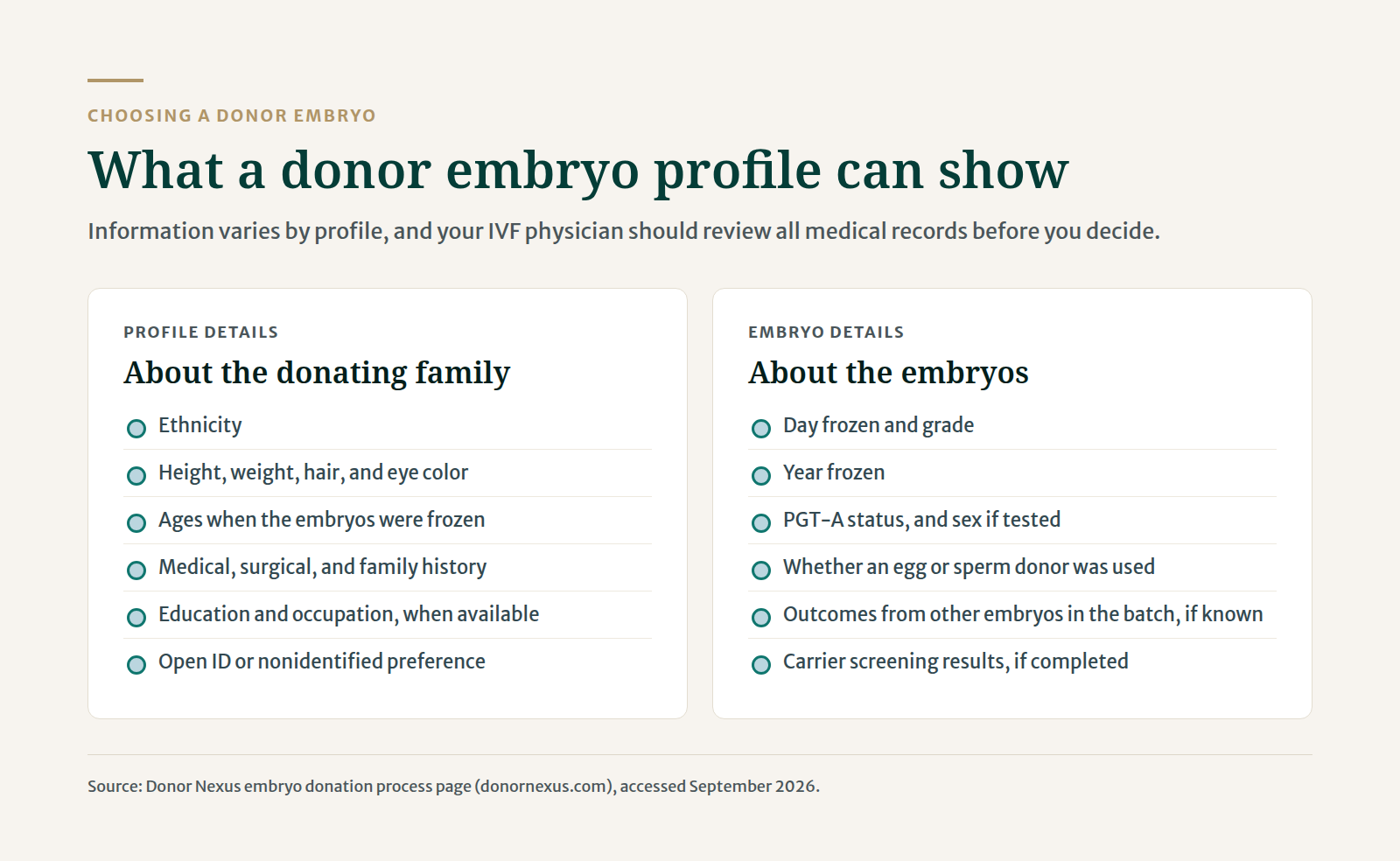
What a donor embryo profile shows, from the donating family's background to the embryos' grade and testing status.
How do you choose a donor embryo step by step?
You choose a donor embryo by browsing profiles, narrowing a shortlist, reviewing the embryo and family details with your physician, and then securing the embryos through Donor Nexus.
- Register and browse. Create a free account at donornexus.com/registration, then browse the embryo bank, where you can filter profiles by the donating mother's and father's ethnicity, genetic testing, and open ID preference.
- Build a shortlist. Save the profiles that match your priorities, whether those center on background, testing status, or the number of embryos included.
- Review grade, day frozen, and testing. Compare each embryo's day frozen and grade, and note whether it has had PGT-A. Our guide to embryo grading explains how to read a profile card such as "Day 6, Grade: XBBB."
- Decide on openness. Consider whether you prefer an open ID or nonidentified profile, since that choice shapes what information may be shared later.
- Have your IVF physician review the records. Share the profile details so your physician can weigh the embryo information and donor health history against your own medical history.
- Contact Donor Nexus. When you find the profile that feels right, let our team know you would like to move forward, and we will begin the process of securing those embryos for your family. We will ask for your name and date of birth to prepare your paperwork, invoice and agreement, and you will have a week to review everything, sign and complete payment, so there is time to read it all carefully. Once your embryos are secured, they come off the database and we send a match sheet to your physician.
After you secure embryos, a physician consultation, pretesting, and a medication calendar lead to a frozen embryo transfer at HRC Fertility in Newport Beach or Encino, and most people finish in about 2 to 3 months from choosing a profile to transfer.2 Pretesting, medications, and monitoring can take place at your local clinic, while the transfer itself requires about 4 days in Southern California.

How are donor embryos screened and tested?
The families who created donor embryos had infectious disease screening before the embryos were created, while genetic testing varies from profile to profile, and most donating couples have not had genetic carrier screening.1
What screening and FDA labeling apply to donor embryos?
Before the embryos were created, the donating family was screened for HIV 1 and 2, HTLV 1 and 2, hepatitis B, hepatitis C, and syphilis.1 When an egg or sperm donor was used, that donor also completed FDA-required laboratory testing. Because embryos created for a couple's own use were not screened to every FDA donor eligibility requirement, federal rules at 21 CFR 1271.90 set out an exception that lets them be donated later with specific labeling, and Donor Nexus describes these embryos as "ineligible but acceptable" for transfer under FDA guidelines.1,3
Because most donating couples have not had genetic carrier screening, talk with your physician about how to weigh a profile without carrier results and whether any family history on the profile deserves a closer look.1
How do PGT-A and sex selection work with donor embryos?
A profile lists the embryos' sex when they have already had genetic testing, and you can request PGT-A on embryos that haven't been tested.1 PGT-A looks at all chromosomes, including the sex chromosomes X and Y, which is how an embryo's sex becomes known.4 You can learn more about gender selection and PGT-A testing at Donor Nexus.
Professional guidance on PGT-A is measured. ACOG notes that false-positive and false-negative results are possible and recommends offering prenatal screening or diagnostic testing to patients who have had PGT-A,4 and ASRM states that the value of PGT-A as a routine screening test for all IVF patients has not been demonstrated.5 ASRM guidance also recommends limiting the transfer of a euploid embryo to one, regardless of age.6 If testing matters to you, ask your physician whether requesting PGT-A fits your plan and how it may affect how many embryos from a profile you use.
What else should you consider when choosing a profile?
Beyond screening and testing, you may also want to weigh three personal factors: whether genetic siblings are possible, how much physical traits and ethnicity matter to you, and how open you want the donation to be.
Can your children be genetic siblings?
Your children can be full genetic siblings when they come from embryos created by the same donors. Each profile you select includes 1 to 3 embryos in the $9,400 program fee, and untested profiles may include 3 or more,2 so using more than one embryo from the same profile across separate transfers can make full genetic siblings possible. Embryo availability can change, so ask the Donor Nexus team how many embryos a profile includes before you decide, and see our breakdown of donor embryo cost for what the fee covers.
How much should physical traits and ethnicity matter?
Physical traits and ethnicity can matter as much or as little as you want, because these preferences are personal and there is no correct weight to give them. You might look for a family resemblance, focus on health history, or balance several factors together. Genetics is also only part of how your family forms, because if you carry the pregnancy, you will not share DNA with your baby, but you are the one who carries and nurtures them, and our post on epigenetics and donor eggs explores that role.
Choosing a donor embryo can also bring up grief about genetics, since your baby won't share your or your partner's DNA. In the short video below, Victoria Niño talks about whether you can fully grieve your genetics before using donor eggs and why acceptance may not fully arrive before you move forward, a question that applies to donor embryos too.
Should you choose an open ID or nonidentified profile?
Whether you choose an open ID or nonidentified profile depends on how much future information sharing you want, and each profile shows the donating family's preference.1 With open ID, the donating family has agreed to release identifying information to the donor-conceived person at age 18 or older on request, and some profiles also offer facilitated video calls without sharing identities. Nonidentified donation involves no identification or contact between the families, although widespread DNA testing means anonymity can't be assured in the future. Our guide to open ID and nonidentified donor embryo options covers both in more detail.

“You were so amazing with helping us select the right embryo and with the whole process. We have referred your facility and HRC to so many people since.”
W.D., intended parent, Orange County, California · Read more from Donor Nexus families
Frequently asked questions about choosing a donor embryo
Can I choose the sex of a donor embryo?
You can when the embryos on a profile have already had genetic testing, because the results identify sex chromosomes and the profile lists the sex. For untested embryos, you can request PGT-A. ASRM recommends transferring one euploid embryo at a time, and your physician can explain what testing involves and how it affects your plans.
How many embryos do I get with a donor embryo profile?
The Donor Embryo Program fee of $9,400 USD includes 1 to 3 embryos from the profile you select, and untested profiles may include 3 or more. The fee also covers administrative costs and one year of storage, while pretesting, medications, and frozen embryo transfer fees are billed separately by the clinic.
Are donor embryos genetically tested?
Some are and some are not. Each profile shows whether the embryos have had PGT-A and, if so, their sex, along with any carrier screening results. Most donating couples have not had carrier screening, so your physician can help you decide whether an untested profile or a request for PGT-A fits your plans.
Can I get more embryos from the same donors later?
It depends on what remains on the profile and whether other intended parents have secured those embryos, so availability can change over time. The Donor Nexus team can tell you what is available now. Ask before your transfer rather than assuming embryos from the same donors will be there for a future sibling attempt.
Does it matter how long a donor embryo has been frozen?
The evidence is mixed. A 2024 single-center study in China linked storage beyond 5 years with lower adjusted odds of live birth,7 while a 2024 meta-analysis found lower rates after longer storage but cautioned that confounding factors could not be ruled out.8 Babies have also been born from embryos frozen about 30 years.9
When you are ready to compare profiles, you can register for free, browse the embryo bank, and bring your shortlist to your physician. If you have questions about a profile, the Donor Nexus team is available at info@donornexus.com or +1 (949) 433-5635, Monday to Friday, 8 a.m. to 4 p.m. Pacific.
Sources
- Donor Nexus. Embryo donation process: embryo information and screening. Accessed September 2026. donornexus.com/embryo-donation-process.
- Donor Nexus. Donor Embryo Program. Accessed September 2026. donornexus.com/embryo-donation.
- US Food and Drug Administration. Human cells, tissues, and cellular and tissue-based products: exceptions from the requirement of determining donor eligibility, and required labeling. 21 CFR 1271.90. ecfr.gov.
- American College of Obstetricians and Gynecologists. Preimplantation genetic testing: ACOG Committee Opinion No. 799. Obstetrics & Gynecology. 2020;135(3):e133-e137. doi:10.1097/AOG.0000000000003715.
- Practice Committees of the American Society for Reproductive Medicine and the Society for Assisted Reproductive Technology. The use of preimplantation genetic testing for aneuploidy: a committee opinion. Fertility and Sterility. 2024;122(3):421-434. doi:10.1016/j.fertnstert.2024.04.013.
- Practice Committee of the American Society for Reproductive Medicine and the Practice Committee for the Society for Assisted Reproductive Technologies. Guidance on the limits to the number of embryos to transfer: a committee opinion. Fertility and Sterility. 2021;116(3):651-654. doi:10.1016/j.fertnstert.2021.06.050.
- Zhan S, Lin C, Lin Q, Gan J, Wang C, Luo Y, Liu J, Du H, Liu H. Vitrification preservation of good-quality blastocysts for more than 5 years reduces implantation and live birth rates. Human Reproduction. 2024;39(9):1960-1968. doi:10.1093/humrep/deae150.
- Zolfaroli I, Romeu Villarroya M, Serralta García LB, Rubio Rubio JM, Monzó Miralles A. Impact of prolonged embryo storage on reproductive and neonatal outcomes: a systematic review and meta-analysis. Journal of Assisted Reproduction and Genetics. 2024;41(10):2691-2700. doi:10.1007/s10815-024-03283-7.
- Hamzelou J. Exclusive: A record-breaking baby has been born from an embryo that's over 30 years old. MIT Technology Review. July 29, 2025. technologyreview.com.
Related reading


Medical disclaimer
This article shares general information about choosing a donor embryo and is not medical advice. Your fertility doctor knows your history and treatment plan, so their guidance comes first. National figures and Donor Nexus outcome data describe past results and do not predict the outcome of any individual cycle.
Last updated October 2026. Figures cited here are drawn from the sources listed above.

Donor Nexus Team
The Donor Nexus Team is the group of case managers, donor coordinators, and egg bank staff who run the agency's Fresh Donor Matching, Frozen Egg Bank, and Embryo Donation programs day to day. Since 2012 they ha…

Ready for the next step?
If you are ready to get started or just need more info, contact us today.